
Living in Costa Rica Safely in 2026: Safety, Cost, and Lifestyle
Living in Costa Rica: A Safe, Healthy, and Genuinely Good Life in 2026
Living in Costa Rica: A Safe, Healthy, and Genuinely Good Life in 2026
People who are thinking about moving to Costa Rica almost always ask the same thing first. Is it safe to live there? It is a fair question, and it deserves a real answer instead of a brochure. So let's talk honestly about what daily life here actually looks like, and why so many North Americans, once they spend real time in this country, end up never wanting to leave.
The short version is this. Costa Rica is one of the most stable, healthiest, and most welcoming places to build a life anywhere in the Americas. It is not a fantasy island with zero problems, and we will not pretend it is. But the things that make people nervous from a distance tend to fade fast once you understand how the country works and where the good life is actually lived.
A country that chose peace a long time ago
Here is something most people do not know. Costa Rica got rid of its army in 1948 and put that money into schools, hospitals, and clean water instead. That single decision shaped almost everything that followed. It is the oldest continuous democracy in Latin America, and it has spent decades pouring close to a fifth of its national budget into social programs every year. You can feel that in the way people treat each other.
On the safety question specifically, the U.S. State Department keeps Costa Rica at a Level 2 advisory, which means "exercise increased caution." That sounds heavier than it is. Level 2 is the exact same rating given to France, Italy, and the United Kingdom. It puts Costa Rica in the company of places people happily visit and live in without a second thought.
The honest picture is that crime here is mostly opportunistic. The single most common issue is petty theft, things like a bag left in a parked car at the beach or a phone snatched in a crowded San José bus terminal. Homicide rates did climb in recent years, and we are not going to hide that. But that increase is overwhelmingly tied to drug trafficking and disputes between criminal groups, concentrated in specific port and downtown areas, and it rarely touches the daily life of residents in the towns where expats actually settle. Most internationals living here go years without encountering violent crime at all, and report feeling safe and at home in their communities.
The smart move, the same one any sensible person makes anywhere, is choosing your town well. The places that consistently show the lowest incident numbers are the mid valley towns like Atenas, Grecia, and San Ramón, the residential pockets of Escazú and Santa Ana, and the smaller coastal villages away from the heavy party crowds. Pick the right spot and apply a little common sense, and Costa Rica feels calm, friendly, and easy to live in.
An economy you can actually plan around
Stability is not just about feeling safe walking to the bakery. It is also about knowing your money is sitting in a country that has its house in order. On that front, Costa Rica is quietly impressive.
The economy grew about 4.6 percent in 2025, and the OECD projects steady growth around 3.5 percent through 2026 and 2027. Inflation has been so tame that it actually went negative for part of 2025, which is the kind of problem most countries would love to have. Public debt, which used to be a real worry, is now falling and is expected to land near 59.5 percent of GDP by the end of 2026. The central bank has been cutting interest rates as things cool off.
Underneath those numbers is a country that has become a magnet for foreign investment. Costa Rica pulls in one of the highest levels of foreign direct investment per capita in Latin America, drawn by political stability, a well educated workforce, and free trade zones. Major medical device and tech companies build here. That matters to you as a future resident because it means jobs, services, infrastructure, and a currency backed by something real.
There is also a detail that makes a lot of retirees and remote workers smile. Costa Rica uses a territorial tax system, which means money you earn outside the country is not taxed locally. Your Social Security check, your pension, your remote salary from a company back home, none of it gets taxed by Costa Rica.
Your money simply goes further here
Let's be straight, because the internet is full of fairy tales about living here for pennies. Costa Rica is not dirt cheap anymore, especially if you want imported groceries and a beachfront condo with the air conditioning running all day. But compared to the United States, it is still a clear win. Overall costs run roughly 18 to 26 percent lower than in the U.S., and many expats report spending 30 to 45 percent less than they would in a mid sized American city.
In real terms, a single person living comfortably in the Central Valley can do it on about 1,600 to 2,400 dollars a month. A couple in that same region often lands between 2,200 and 3,200 dollars. Move to a popular beach town like Tamarindo or Nosara and you should plan for more, often 2,500 to 4,000 dollars or higher, mostly because of rent, imported food, and cooling costs near the coast. The single biggest lever you control is whether you live like a local or import your old life wholesale. Shop at the weekly farmers market, eat at the neighborhood sodas, and your budget stretches a long way.
Property is another pleasant surprise. Annual property taxes sit around a quarter of one percent of the registered value, which is a fraction of what most North Americans are used to paying.
Healthcare that quietly outperforms its budget
This is where Costa Rica really shows off. The country runs a universal public health system called the Caja, which all legal residents join, with contributions based on income. Alongside it sits a strong private system that many expats use for shorter wait times and English speaking doctors. A standard private doctor visit runs about 60 to 75 dollars, and a specialist around 100. Costa Rica ranks 48th in the world on Numbeo's 2026 Healthcare Index, ahead of countries like Greece, Hungary, and Ireland, which is remarkable for a middle income nation that spends a tiny fraction of what the U.S. spends per person.
The results speak for themselves. Costa Ricans live, on average, longer than people in the United States.
The Blue Zone secret on the Nicoya Peninsula
Costa Rica is home to one of only a handful of Blue Zones on the planet, those rare pockets where people routinely live past 100 in good health. The Nicoya Peninsula sits in that elite club alongside Sardinia, Okinawa, Ikaria, and Loma Linda.
The research behind it is serious, not wellness marketing. Studies out of Stanford and the University of Costa Rica found that a 60 year old man in Nicoya has roughly seven times the chance of reaching 100 compared to a man in Japan, a country already famous for long life. Average life spans in parts of Nicoya have reached around 85, well above the U.S. figure. Scientists point to a mix of things: a simple diet of rice, beans, squash, and corn, a lifetime of natural physical activity, deep family ties, strong friendships, plenty of sunshine, and what locals call the plan de vida, a clear reason to get up in the morning. You cannot bottle that, but you can move somewhere that lives it every day.
A climate you get to choose
People say "tropical" like it means one thing. In Costa Rica it means about a dozen different climates packed into a country smaller than West Virginia, and you get to pick the one that fits you.
The Central Valley, where the capital sits at around 3,800 feet, is famous for what locals call eternal spring. Daytime temperatures hover comfortably in the 70s Fahrenheit year round, evenings cool off nicely, and you rarely need heating or air conditioning. That alone keeps utility bills low and life simple. The Pacific northwest, Guanacaste and the Nicoya Peninsula, gives you a long bone dry season from December through April and that classic beach weather. The South Pacific is lusher and more humid, the Caribbean side stays green and rainy through much of the year, and the mountain towns like Monteverde stay cool and misty.
The practical takeaway is to see any place you love in both the dry and the green season before you commit. The same hillside can feel like two different worlds in February and September.
Where North Americans are actually putting down roots
A few regions have become real homes for the expat community, each with its own personality.
The Central Valley is the steady, sensible favorite. Towns like Atenas, Grecia, Escazú, and Santa Ana combine that perfect spring climate, easy access to the international airport and top hospitals, and the lowest cost of living in the country. It is where a lot of retirees and families land first, and many never feel the need to move.
Guanacaste and the Gold Coast are the beach dream. Tamarindo, Playa Flamingo, Sámara, and Nosara offer mature expat communities, gorgeous Pacific beaches, and a steady stream of multi million dollar developments. Prices are higher, but so is the lifestyle.
The South Pacific around Uvita and Dominical is the up and coming play, where the mountains tumble straight into the ocean. It is less developed and a bit farther from the main airport, but it is growing fast, with new luxury hotels and an international airport in the works. And the Central Pacific around Jacó and Quepos splits the difference, giving you beach access without the highest Guanacaste price tags.
You are in surprisingly good company
If you still wonder whether Costa Rica is a serious place to own a home, consider who already does. Mel Gibson bought a sprawling jungle estate on the Nicoya Peninsula years ago, drawn by the privacy and the raw beauty. Tom Brady and Gisele Bündchen put down roots near Santa Teresa, also on Nicoya, and Gisele has spoken about how time seems to stop for her there. Mark Zuckerberg has been linked to a beachfront property in the same quiet stretch of coast.
The list of famous names who own here, vacation here regularly, or have been spotted relaxing here runs long, from athletes like Michael Jordan, Shaquille O'Neal, Andre Agassi, and Steffi Graf, to a steady rotation of Hollywood faces. The reason is always the same. Costa Rica offers two coastlines, world class natural beauty, and a live and let live culture that lets people unwind without crowds or cameras. When some of the most mobile, security conscious people on earth choose this country for peace and privacy, that tells you something.
Owning property here is easier than you think
One of the quiet advantages that surprises a lot of buyers is this. Foreigners in Costa Rica have essentially the same property rights as citizens. You can own land outright, in your own name, with full title, anywhere except the narrow maritime concession zone right along the beach. Closing costs typically run about 3 to 4 percent, transfer taxes around 1.5 percent, and as mentioned, annual property taxes are wonderfully low.
That legal security, combined with a stable economy and steady demand from international buyers, is exactly why Costa Rica real estate has held up so well and why building a home here is a sound long term move, not just an emotional one.
Building your place in paradise
This is the part where a safe country, a healthy lifestyle, and the right piece of land turn into an actual home. That is what we do at Ticonstru. Since 2018, we have built custom homes for people coming from North America and beyond, and our Viva Turnkey approach is designed to take the stress out of building from abroad.
Turnkey means exactly what it sounds like. We handle the whole journey, from design and permits to the final handover of the keys, so you are not trying to manage a construction project from another country. Our Viva Turnkey pricing starts at 1,450 dollars per square meter for high end builds and 1,700 dollars per square meter for luxury, and that already includes all professional fees and permits. No surprise line items buried at the end.
Costa Rica gives you the safety, the stability, the climate, and the longevity. We help you build the home where you will enjoy all of it.
Ready to start?
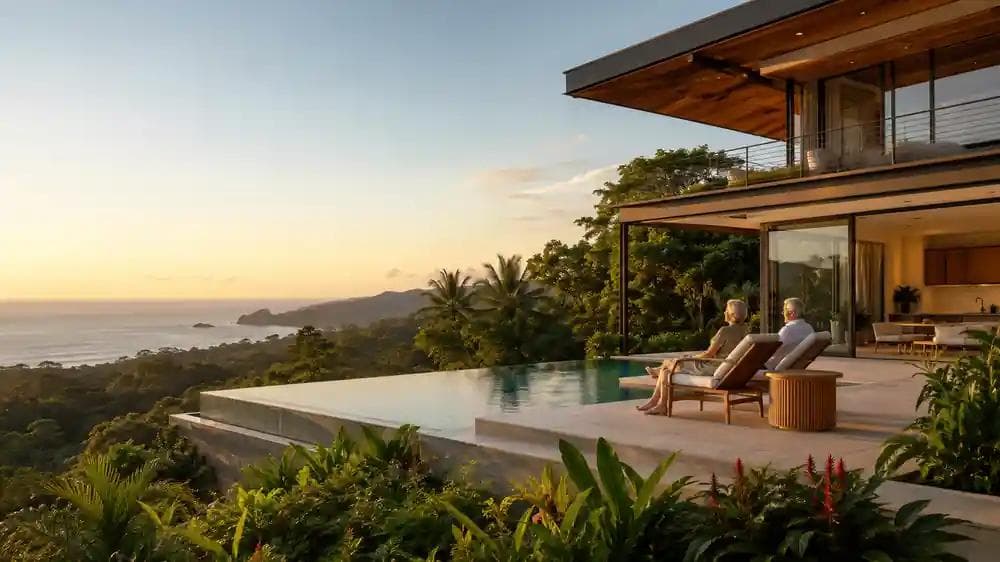
If you have been picturing a life on a hillside with an ocean view, or a calm valley home where the weather is perfect and your money goes further, let's make it real. Reach out to Ticonstru today and tell us what you are dreaming about. We will walk you through what it takes to build it, the right way, in one of the best places on earth to call home.
Interested in building?
Talk to us about your project.
WhatsApp is the fastest way to reach us. Or use the quote form for something more detailed.