
Building on Sloped Land in Costa Rica: A Practical Guide
What sloped construction actually involves in Costa Rica: geotechnical requirements, foundations, drainage, pilings vs cut-and-fill, and what it costs compare
Some of the best lots in Costa Rica are on slopes. The views are better, the privacy is real, and the architecture can be genuinely interesting. They also cost more to build on and require more upfront work than flat land. This guide covers what that actually means in practice: the engineering, the regulations, the construction methods, and how to think about the cost tradeoffs.
What changes when you build on a slope
The fundamental challenge of sloped construction is that everything flat-land building takes for granted has to be created. A level building pad, stable soil below the foundation, controlled water runoff, and safe access for machinery and materials all require deliberate engineering on a slope rather than being a given condition of the site.
The steeper the slope, the more significant each of these requirements becomes. Costa Rica's building code requires special engineering measures for slopes above 30 percent grade. Below that threshold, the measures are fewer but the principles are the same.
Geotechnical study: the first step on any sloped lot
Before any design work begins on a sloped lot, a geotechnical study is required. This is not optional and it is not a formality. The study tells you what you are building on: soil composition at depth, load-bearing capacity, groundwater presence, rock location, and the risk of differential settlement or slope failure.
A typical study involves drilling at multiple points across the lot, collecting soil samples, and running standard penetration tests to assess soil strength. The results determine what foundation type is appropriate, how deep it needs to go, and what drainage measures are necessary.
For slopes above 30 percent, a slope stability analysis is also required. This evaluates landslide risk and establishes what mitigation measures are needed before construction can proceed. CFIA will not approve structural drawings without this documentation for steeper sites.
Skipping or shortcutting the geotechnical study is the single most expensive mistake you can make on a sloped lot. Problems that are discoverable before construction become structural failures during or after it.
Regulations for sloped construction in Costa Rica
Sloped construction is regulated at two levels: national standards through CFIA and municipal regulations that vary by location.
At the national level, CFIA requires geotechnical studies and slope stability reports as part of the plan approval process. On slopes above 30 percent, additional measures are typically required including specific drainage systems and in some cases reforestation of disturbed areas.
At the municipal level, regulations vary significantly. In coastal zones under maritime zone jurisdiction, building height restrictions and design requirements that minimize visual impact are common. In ecologically sensitive areas like parts of the Nicoya Peninsula in Guanacaste, limitations on structure type and footprint apply to protect local biodiversity.
Verify the specific municipal regulations for your lot before committing to a design. What is permitted varies enough between municipalities that what works on one lot may not be approved three kilometers away. For the full permit sequence, see the complete guide to building in Costa Rica.
Foundation options for sloped sites
Pilings and elevated structure
Piling construction raises the structure on columns that anchor into stable ground, allowing the building to sit above the slope rather than requiring the slope to be modified. This approach works particularly well on rocky sites where excavation is expensive, on ecologically sensitive lots where minimizing ground disturbance matters, and on sites where the design intentionally uses the slope to create dramatic cantilevers or elevated terraces.
The advantages: less earthmoving, less environmental impact, faster site preparation, and a building that reads as part of the landscape. The tradeoffs: the piling structure requires reinforced columns and beams designed for both vertical loads and seismic forces, and the elevated building creates more complex waterproofing requirements at the ground interface.
Cut and fill
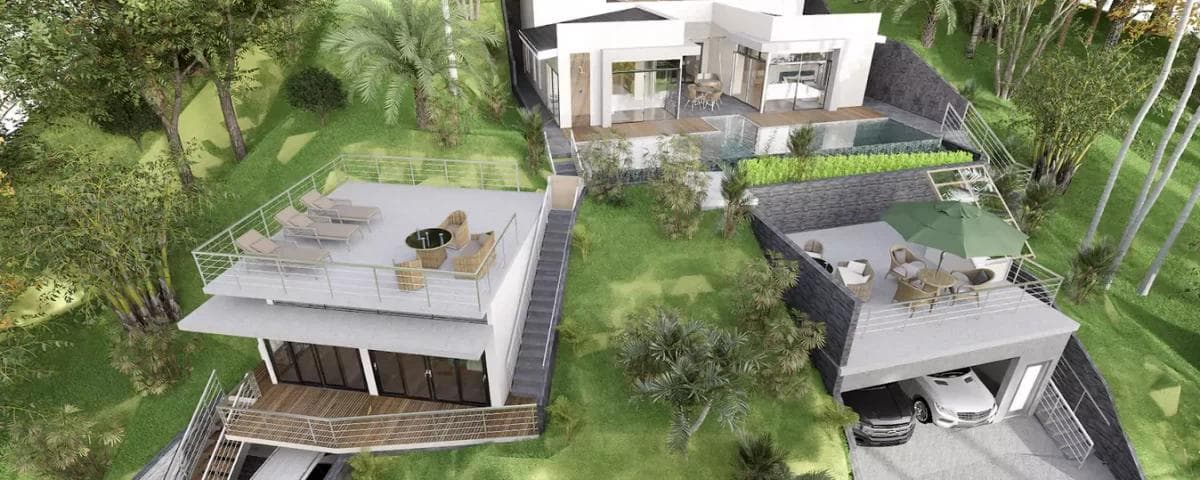
Cut and fill modifies the terrain to create level platforms for construction. The higher parts of the slope are excavated, the material is used to fill the lower areas, and a series of terraces is created that allow more conventional building methods. This approach suits softer soils where excavation is practical and sites where integrating the building directly into the landscape is the design priority.
The advantages: more conventional construction methods once the platform is established, outdoor spaces that integrate naturally with the terrain, and greater flexibility in landscape design. The tradeoffs: significant earthmoving costs, the need for robust retaining walls to maintain terrace stability, and more complex drainage engineering.
Both approaches require retaining walls in most sloped construction scenarios. The walls must be designed for specific soil loads, waterproofed to prevent water infiltration, and built to a standard that will hold through decades of Costa Rica's rainy seasons. Retaining wall failures are expensive and dangerous. Do not economize here.
Drainage: the most critical system on a sloped site
Water management on a sloped site is not optional. In Costa Rica's rainy season, particularly in Puntarenas and the South Pacific where rainfall is heavy, water that is not actively managed will find its own path, and that path will typically be through or under your building.
A properly engineered drainage system includes surface channels that intercept runoff before it reaches the building, subsurface drains that manage groundwater and prevent hydrostatic pressure on retaining walls, and a drainage layer behind retaining walls to prevent water accumulation. The system must be designed with maintenance access in mind because drains that cannot be cleaned will eventually fail.
SETENA and local municipalities both impose environmental requirements on drainage design in coastal zones. Compliance with these requirements is part of the permit process, not an afterthought.
Construction logistics on difficult terrain
Getting materials and equipment to a sloped construction site adds cost and time that flat-site builders do not face. Depending on the access road grade and site configuration, you may need temporary access roads, cranes or specialized lifting equipment for materials, and more hands-on labor for distribution across different site levels.
In remote coastal areas of Guanacaste or the Nicoya Peninsula, this logistical complexity is amplified by distance from supply centers. Budget these logistics costs explicitly rather than assuming they are included in a standard construction estimate. A contractor quoting a per-square-meter rate without factoring in site-specific access conditions is giving you an incomplete number.
What sloped construction costs more
Construction on a sloped lot typically runs 20 to 30 percent more than equivalent construction on flat land. The premium comes from several compounding factors:
- ◆Foundation engineering: deeper, wider, and more complex than flat-site foundations
- ◆Retaining walls: necessary on most sloped sites, expensive to build properly
- ◆Drainage systems: more extensive and more engineered than flat-site drainage
- ◆Site preparation: earthmoving, temporary roads, and platform creation
- ◆Logistics: additional equipment and labor for material handling on difficult terrain
- ◆Geotechnical study and slope stability analysis: required upfront costs before design begins
These costs are real and should be factored into the land purchase decision. A sloped lot priced significantly below comparable flat lots may pencil out correctly once the construction premium is added. Run the full numbers before you fall in love with the view. For realistic construction cost ranges by province and finish level, see our guide on construction costs in Costa Rica.
Why sloped land is worth it
Views. A well-sited home on a slope in Guanacaste or the South Pacific captures ocean views and a visual connection to the landscape that flat lots at the same location simply cannot offer. In the vacation rental market, a home with genuine views commands meaningfully higher nightly rates and lower vacancy than an equivalent home without them.
Architecture. Sloped sites produce better architecture. The constraints of the terrain force design responses, and those responses, when done well, produce homes that are more interesting and more integrated with their setting. Cantilevers, split levels, terraced outdoor spaces, and buildings that read as part of the hillside are all products of designing honestly for a slope.
Privacy. Elevation and topography create natural separation from neighbors in a way that flat land cannot manufacture. On a hillside lot, the slope itself provides a buffer.
Value. In Costa Rica's coastal real estate market, view properties with interesting architecture consistently outperform flat-site properties at resale and rental performance. The construction premium is typically recaptured in the finished property value.
Working with the right team
Sloped construction is not a good place to figure things out as you go. The geotechnical study, the structural engineering, the drainage design, and the construction logistics all require professionals with specific experience on difficult terrain. A team that is very good at flat-site residential construction may not have the right experience for a challenging hillside project.
Ask specifically about previous sloped projects. Ask to see them. Ask the engineers about their experience with slope stability analysis and retaining wall design. Ask the contractor about their experience with the specific site access challenges of the area where you are building.
Our Viva turnkey program handles architecture, structural engineering, geotechnical coordination, permits, and construction under a single contract, which is particularly valuable on sloped sites where the coordination between these disciplines is more critical than on straightforward flat-site builds. If you are considering a sloped lot, our land and build service includes a technical assessment of the site before you commit to the purchase.
Frequently asked questions
How much more does it cost to build on a slope?
Typically 20 to 30 percent more than equivalent construction on flat land, depending on the severity of the slope, soil conditions, and site access. The main cost drivers are foundations, retaining walls, drainage, and logistics.
Is a geotechnical study required?
Yes. CFIA requires it as part of the structural plan approval process for sloped sites. For slopes above 30 percent, a slope stability analysis is also required. Beyond the regulatory requirement, the study is essential for designing a foundation that will actually work on your specific site.
What slope grade triggers special regulations?
Slopes above 30 percent require additional engineering measures and more stringent regulatory review.
Can I build a pool on a sloped lot?
Yes, and hillside pools are some of the most dramatic in Costa Rica. The pool structure needs to be engineered for the slope conditions specifically, and the drainage design must account for pool water management. See our pool construction service for how we approach pools on challenging terrain.
Which is better: pilings or cut and fill?
It depends on the soil, the slope grade, and the design goals. Rocky sites favor pilings. Softer soils with moderate slopes can go either way. The geotechnical study results and your architect's design intent together drive the decision.
Do I need special permits beyond the standard building permit?
Possibly. SETENA environmental review requirements depend on the site's environmental category. Municipal regulations in coastal zones add additional layers. The permit requirements for your specific lot depend on its location, slope grade, and proximity to protected areas or water bodies.
Ready to start?
Talk to us about your project.
The fastest way is WhatsApp. If you prefer, use the quote form and we will come back within one business day.