Green Building in Costa Rica: Designing the Sustainable Future of Your Home
Sustainability is more than just a trend; it has become an imperative necessity for modern construction, especially in a country like Costa Rica, which is a […]
Costa Rica generates the vast majority of its electricity from renewable sources and has committed nationally to full decarbonization by mid-century. Building sustainably here is not a trend layered on top of the construction process. It is increasingly the baseline, shaped by regulation, climate, and the expectations of the buyers and renters who make up the market for quality properties.
This article covers the core elements of sustainable home construction in Costa Rica: smart design for the tropical climate, solar and energy systems, water management, materials, and the regulatory environment that governs all of it.
Designing for the climate first
The most effective sustainable building decisions happen at the design stage, before any materials are specified or systems are sized. A home designed to work with Costa Rica's tropical climate requires less mechanical intervention to stay comfortable, which reduces operating costs from day one.
Orientation. How the house sits on the lot relative to the sun path and prevailing breezes determines how much passive cooling is possible. A well-oriented home in Guanacaste or Puntarenas can stay comfortable without continuous air conditioning through most of the year. A poorly oriented one fights the climate constantly.
Cross ventilation. Positioning openings on opposite sides of the home so air moves through naturally. Hot air rises and exits through high openings; cooler air enters through low openings on the windward side. This is free to design in and expensive to retrofit.
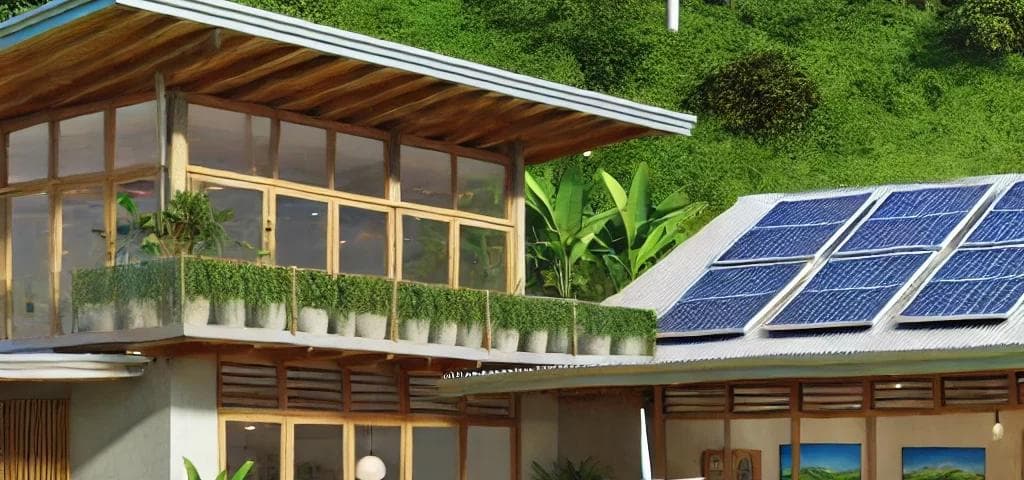
Roof overhangs. Extended eaves protect walls, windows, and terraces from the heavy tropical rain common across both Guanacaste and Puntarenas. They allow windows to stay open during rain and reduce solar heat gain on walls.
Natural light without heat gain. Large openings on appropriate facades capture daylight without the overheating that comes from unshielded west-facing glazing. Properly designed shading elements, louvers, and deep window reveals manage this balance.
At Ticonstru, these design principles are integrated from the first site assessment through the final architectural drawings. Our custom homes service and Viva Turnkey program both address passive design as a foundation, not an afterthought.
Solar energy: the practical case in Costa Rica
Costa Rica's grid runs primarily on hydroelectric and other renewable sources, which changes the environmental argument for solar compared to fossil-fuel-heavy grids. The practical case here is energy independence, protection from rate increases, and resilience during grid outages.
Grid-tied photovoltaic systems
Solar panels feed power into the ICE grid through a net-metering arrangement. When the system produces more than the home consumes, the surplus is credited against future bills. This is the most common solar installation for homes that want to reduce their electricity costs without adding battery infrastructure.
Hybrid systems with battery storage
Solar panels paired with battery storage allow the home to operate independently during grid outages and reduce peak-hour grid dependence. The right choice for remote properties, vacation homes where reliability matters, or owners who want genuine energy independence. Higher upfront cost, justified by the operational benefits for the right use case.
Solar water heating
Separate from photovoltaic, solar thermal systems use rooftop collectors to heat domestic water directly from the sun's energy. Cost-effective in Costa Rica's climate with short payback periods. A standard recommendation on most Ticonstru builds given the consistent solar resource across both dry and green seasons.
Every solar installation is site-specific. Panel orientation, shading from surrounding vegetation or structures, roof pitch, and household energy consumption all affect system sizing and performance. Ticonstru's solar and green building service evaluates each project individually and designs the system to match the home's actual energy profile rather than applying a generic specification.
Wind energy
Wind energy at the residential scale is viable in specific locations where winds are consistent and strong, particularly in parts of Guanacaste's mountains and certain coastal exposures. A small residential turbine can complement a solar system, generating electricity at night and on cloudy days when photovoltaic output is reduced.
The viability depends entirely on site-specific wind assessment. Ticonstru conducts feasibility analysis on projects where wind is a candidate energy source, evaluating wind flow patterns, terrain topography, and local regulations before recommending an installation. Where the conditions are right, a hybrid solar-wind system maximizes energy independence and minimizes operating costs.
Water management systems
Water is a critical resource in Costa Rica's coastal communities, and smart water management is both an operational and a sustainability priority. Ticonstru integrates the following systems depending on site conditions and client priorities:
Rainwater harvesting. Roof runoff collected and stored in tanks for irrigation, pool top-up, and with appropriate filtration as a supplementary water source. Particularly valuable in areas with seasonal rainfall variation or where ASADA supply is limited.
Cisterns. Underground storage tanks buffer supply interruptions from ASADA or AyA systems. Standard on most Ticonstru builds in areas where supply reliability is variable.
Water treatment. Inline filtration and UV sterilization for potable water, sized to the water source. Well water typically requires more treatment than municipal supply. Reverse osmosis for drinking water is common on coastal properties.
Greywater reuse. Systems that treat water from sinks and showers for reuse in irrigation. Reduces potable water consumption and is increasingly standard on sustainability-focused builds. Relevant both for environmental reasons and for operational cost reduction on properties with high irrigation demand.
Sustainable materials
Material selection in Costa Rica involves balancing sustainability, durability, and performance in a climate that is aggressive on anything not specified correctly. The same material that works well in a temperate climate may fail within a few years in a high-humidity coastal environment.
The priorities for sustainable material selection at Ticonstru:
- ◆Locally sourced where performance allows. Reduces transportation emissions and supports local suppliers. Many excellent construction materials are produced in Costa Rica or sourced regionally.
- ◆Climate-appropriate above all. A material with strong sustainability credentials that fails prematurely in the coastal environment is neither sustainable nor economical. Durability is part of the sustainability calculation.
- ◆Certified wood. Where wood is specified for structural or finish elements, certified sustainable sources are standard. Costa Rica's legal framework requires documentation of timber origin.
- ◆Recycled and low-embodied-carbon materials. Recycled aggregate, supplementary cementitious materials, and products with documented environmental credentials are increasingly available in the Costa Rican market.
For sloped sites where construction complexity and environmental sensitivity intersect, material choices also affect the project's relationship with the terrain. See our guide on building on sloped land in Costa Rica for how site conditions shape these decisions.
The regulatory framework
Costa Rica's environmental regulations directly affect every construction project, particularly those in coastal, protected, or ecologically sensitive areas. Understanding the framework before you buy land is essential.
SETENA environmental review. The environmental regulatory body categorizes projects by their potential environmental impact. Standard residential projects in appropriate locations typically fall into the fast D3 category. Projects in sensitive areas, near water bodies, or in coastal zones may require D2 or D1 review, which adds significantly to the permit timeline. Identifying your lot's SETENA category before purchase is part of responsible due diligence.
Maritime Zone Law (Ley 6043). The first 200 meters from the high tide line is public domain. The next 150 meters is Zona Restringida where development is subject to concession terms. Environmental requirements in this zone are more stringent than for titled inland property.
National Decarbonization Plan. Costa Rica's roadmap to full decarbonization sets the policy direction for construction incentives and regulations. The plan includes incentives for energy-efficient and renewable energy installations in residential construction. Staying current with these incentive programs is part of Ticonstru's advisory role for clients.
Building permits and CFIA. The Colegio Federado de Ingenieros y Arquitectos reviews all construction plans before permits are issued. Sustainable design elements, energy systems, and water management infrastructure must be documented in the construction drawings submitted for review. The full permit sequence is covered in our complete guide to building in Costa Rica.
How Ticonstru integrates sustainability
Sustainability at Ticonstru is integrated across all services, not offered as an add-on package. The passive design principles described above are part of every architectural project. The solar, water, and landscape systems we deliver are evaluated per project rather than applied generically.
The relevant services for clients who want to build sustainably:
- ◆Viva Turnkey. The full build from design to occupancy permit, with sustainability integrated from the initial site assessment through material specifications and systems design.
- ◆Solar and green building service. Site-specific evaluation and design of photovoltaic systems, solar water heating, battery storage, and wind energy where applicable. Each installation is sized and specified for the home's actual energy profile.
- ◆Landscape service. Native planting, drainage design, irrigation systems, and site work that works with the natural topography rather than against it.
- ◆Pool construction service. Pool systems specified for the environment, including saline systems for coastal properties and solar heating where applicable.
- ◆Custom homes service. Architectural design that starts with the site, the climate, and the client's program before any aesthetic decisions are made.
For clients evaluating a lot, our land and build service includes a site assessment that covers the sustainability profile of the lot: solar exposure, wind potential, water access, drainage characteristics, and SETENA category. Available lots we have already assessed are on our land listings page.
To start a conversation about building sustainably in Costa Rica, get a quote here or reach us on WhatsApp.
Interested in building?
Talk to us about your project.
WhatsApp is the fastest way to reach us. Or use the quote form for something more detailed.